Spirituality — Book Review
Trust, Not Certainty: The Book and the Song in the Same Lane
November 26, 2026
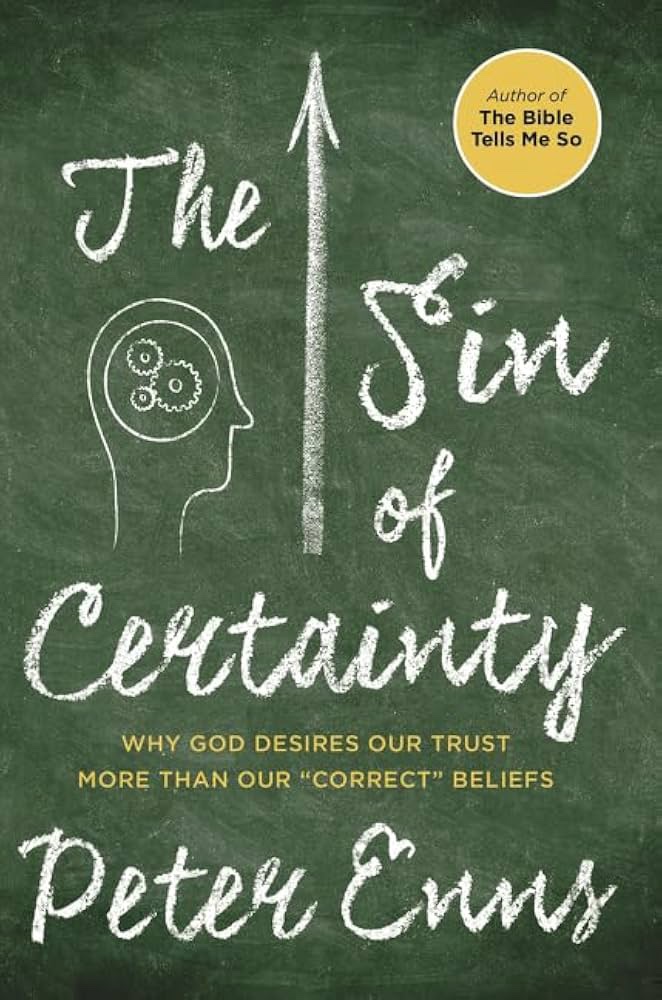
A rock song about people performing certainty. A theology book that calls certainty a sin. Neither one came from the other — they run in the same lane, asking the same questions of the same people.

The Book and the Song Ask the Same Questions
The book is The Sin of Certainty: Why God Desires Our Trust More Than Our “Correct” Beliefs, by Peter Enns, published by HarperOne in 2016. Enns is a biblical scholar, trained at Westminster Theological Seminary and Harvard, who spent years inside a faith built on having the right answers. Then the answers stopped holding. The book opens on an airplane, where he’s watching a Disney movie and finds its picture of God ringing truer than the one he was taught. He calls those moments “uh-oh moments” — when what you thought you knew no longer fits — and says they’re the invitation to a deeper faith, not the end of one.
His argument turns on one sentence: faith isn’t the same thing as being certain about what you believe. Certainty becomes a sin, in his telling, when it turns into an idol. When needing to be right matters more than trusting God, we shrink God down to the size of what we can understand, and then we worship the understanding instead of God. It’s the golden calf again, only the idol is made of ideas instead of metal.
The Bible itself never asked for that kind of certainty, Enns argues. The Psalms argue with God. Job demands answers and gets a whirlwind instead. The book’s answer is trust — not trust in your own thinking, but trust in a person. Beliefs still matter, and he says so plainly. But they’re not the center. Trust is.
“Decouple our faith in God from our thoughts about God. That way faith doesn’t rest on correct thinking.” — Peter Enns, The Sin of Certainty
The Book Argues It. The Song Asks It.
The song is “A World of Pretenders,” written by Franklin McKay and Harry Hess, from Matthew 10:16 — “wise as serpents, and harmless as doves.” It opens with the oldest questions there are: Is there a heaven? Is it a lie? Divine creation, or a simple roll of the dice? It doesn’t pick a side. It just puts the uncertainty out in the open, the questions plenty of people ask and almost nobody says out loud.
Then it turns on the people doing the pretending. “The holy are broken, on their knees.” It cuts two ways: sincere believers humbled before God, or people wounded by the institutions that were supposed to hold them. And the wolves in sheep’s clothing, straight from Jesus’ warning in Matthew 7:15 about false teachers who look righteous and exploit the trust placed in them. “Faith revealed as greed” is the charge against the ones who use religion for power, money, and status. The point isn’t that faith is false. It’s that some of the people claiming it are pretending. The chorus hands the verdict to the only judge who can’t be fooled: only God knows what’s forged and what’s real. “Forged” does double work — counterfeit, a fake imitating the real thing, or forged through fire, made stronger by hardship. The lyric leaves both readings standing.
It ends where it started, at a crossroads, with every minute in doubt — faith or skepticism, truth or convenience, and the question of whether what we believe is real or just performed. Enns would recognize the place. The book makes the case for trust over certainty. The song stands on the same ground, asking the same questions with a chorus.
The song has found its listeners the slow way. Effect Radio has played it 134 times, and the count keeps climbing. This week the song’s home page grew two new pages: a lyric audiobook that takes the song apart verse by verse, and a full review of Enns’ book — the first book review on the song’s site.
If the book spoke to you, hear the song. Read the full review at aworldofpretenders.com/book-review/, hear the lyric taken apart in the lyric audiobook, and buy the book from HarperCollins. The people the book speaks to are the same people the song was written for — readers wrestling with faith, doubt, and the demand to be certain. Two works, one lane — the book argues it, and the song asks it with a chorus.
Listen to “A World of Pretenders”: Spotify · YouTube · Lyrics · The book review · The lyric audiobook
Written by Franklin McKay and Harry Hess. From Matthew 10:16. Master owned by Franklin McKay. Hear it all at franklinmckay.com.
the daily · franklin mckay